Descriptions
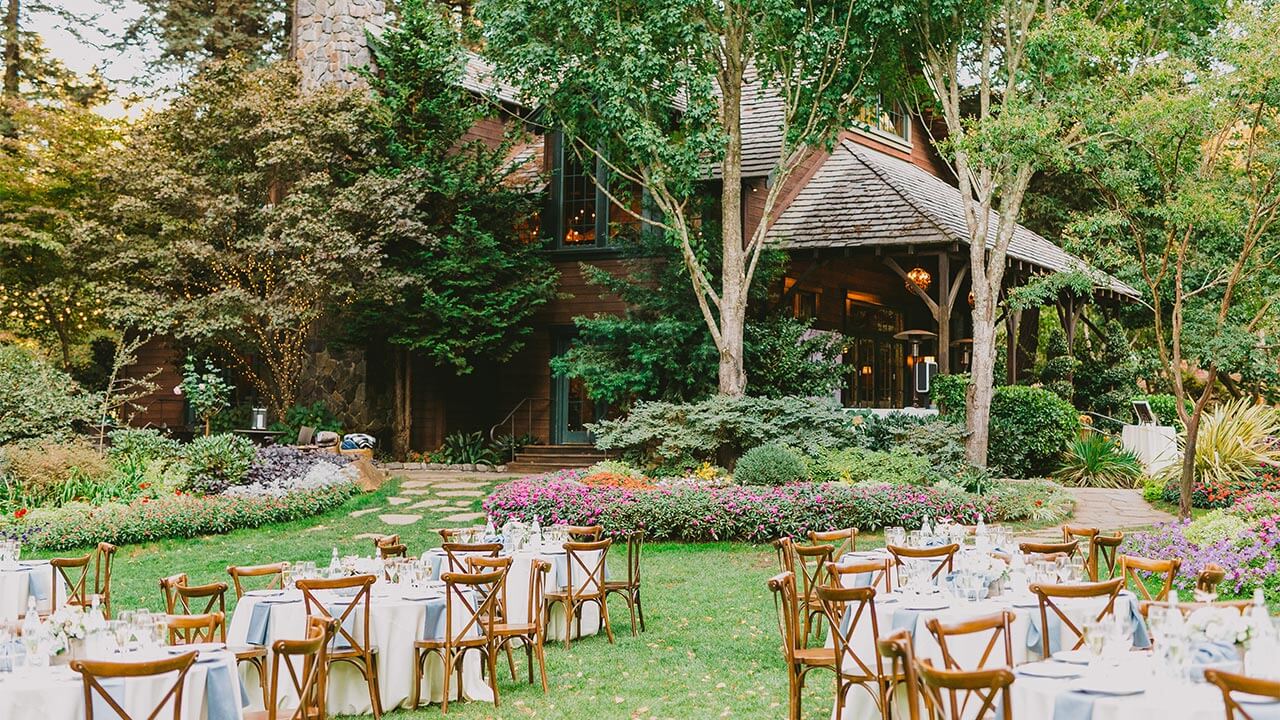
i-MXvVczF-4K
This is a beautifully composed, tranquil outdoor scene — likely set up for a wedding reception or an elegant garden party — located on the lush, landscaped grounds of a stately, rustic-style home.
### The Setting & Architecture
At the center and background of the image stands a large, charming house with a distinctly rustic or Arts and Crafts aesthetic. Key architectural features include:
- **Material & Structure**: The exterior walls are clad in rich, dark-stained shingles or wood siding, giving it warmth and texture. A prominent, textured stone chimney rises from the left side of the roofline.
- **Roof**: The roof is steeply pitched with dark shingles that match the walls, featuring multiple gables and overhanging eaves. One section of the roof extends to form a covered porch or veranda.
- **Windows & Doors**: Tall, narrow windows with green-framed panes glow softly from warm interior lighting, suggesting evening or twilight. Glass doors beneath the covered porch area also emit a soft golden light, hinting at activity inside. A set of stairs leads up to the main entrance.
- **Porch Features**: Under the wide overhang of the porch roof, wooden beams and posts frame the entryway. Hanging lanterns or pendant lights provide ambient illumination. A small umbrella and seating suggest an intimate outdoor nook even under cover.
### The Garden & Landscaping
The property is surrounded by mature, verdant landscaping that contributes profoundly to the romantic, bucolic atmosphere:
- **Trees & Shrubs**: Large, leafy deciduous trees (possibly oaks or maples) drape their branches overhead, providing natural canopy and framing the house. Beneath them, dense shrubbery, ornamental grasses, and carefully manicured evergreen hedges add layers of greenery.
- **Floral Beds**: Vibrant flowerbeds run along the edge of the lawn and around the garden beds — particularly eye-catching are clusters of pink, purple, and red blossoms. There’s also a bed of white and yellow blooms closer to the house.
- **Ground Features**: Stone pavers form a circular or winding path leading toward the house. In one area near the porch, stepping stones meander through mossy ground or mulch. Small decorative lights (possibly fairy or string lights) are wrapped around tree trunks or woven into foliage, adding magical twinkle to the dusk setting.
### The Event Setup
In the foreground, numerous round tables are arranged across the well-manicured lawn

oscar-sutton-yihlaRCCvd4
This is a vibrant, joyful photograph of a medium-sized dog, likely a Nova Scotia Duck Tolling Retriever or similar reddish-brown retriever breed, captured mid-stride on a beach at what appears to be sunrise or sunset.
**The Dog:**
- **Breed & Appearance:** The dog has a rich, dense coat of reddish-brown (or copper) fur. Its ears are floppy and slightly back due to motion. It has a friendly, open expression with dark, alert eyes looking straight toward the camera.
- **Expression & Pose:** The dog is captured in motion — running energetically out of the water toward the viewer. Its mouth is wide open in a happy “smile,” showing its pink tongue and teeth. Its tail is curled up and forward over its back, also indicating excitement and movement.
- **Details:** A black collar with two silver-colored tags — one circular, one possibly oval or bone-shaped — is visible around its neck.
**Setting & Environment:**
- **Foreground:** The dog’s paws are plowing through white, foamy ocean surf that’s washing up onto a shoreline made of smooth, rounded pebbles and small stones. The pebbles vary in color — gray, brown, white, and even hints of purple or metallic sheen — suggesting a well-trodden coastal area.
- **Midground:** Behind the dog is the calm but gently rippling blue sea, which stretches to the horizon. Small waves are breaking near the shore, creating the white foam surrounding the dog.
- **Background:** The sky above the horizon is softly lit with warm tones — soft yellow, peach, and pale orange — characteristic of the golden hour (sunrise or sunset). The upper part of the sky fades into very light blue or almost white.
**Photographic Style:**
- **Focus & Depth-of-field:** The image uses a shallow depth of field, keeping the dog sharply in focus while the background (ocean and sky) is softly blurred. This isolates the subject and draws attention to its joyful expression and motion.
- **Lighting:** The lighting is soft and warm, enhancing the natural warmth of the dog's coat and creating a serene, picturesque mood.
- **Composition:** The dog is centered and placed low in the frame, emphasizing its dynamic movement coming toward the viewer. The horizon line sits roughly across the middle third of the image, following the rule of thirds for pleasing composition.
- **Mood:** The overall mood is one of pure joy

amber-kipp-75715CVEJhI
This is a beautifully composed, intimate portrait of an orange tabby cat, likely a Maine Coon or a similar long-haired breed, captured in a moment of curiosity and wonder.
**The Cat:**
- **Breed & Appearance:** The cat has luxurious, long, fluffy fur with classic orange and cream tabby markings. Distinctive “M” stripes are visible on its forehead, and it has prominent white fur around its chest and paws.
- **Face & Expression:** Its head is tilted upward, eyes wide and bright green, gazing intently at something out of frame above. This creates a sense of wonder, awe, or alertness. Its nose is pink, and its whiskers—long, straight, and white—are fanned out to the sides. Its ears are tall, pointed, and slightly tufted, also oriented forward, indicating focused attention.
- **Posture:** The cat is lying down on a wooden surface with its front paws stretched comfortably forward over the edge. Its body extends back into shallow focus, suggesting relaxation, yet its head posture conveys active engagement.
- **Paws:** The front paws are clearly visible, soft and well-furred, resting gently on the wood.
**Setting & Background:**
- **Foreground:** A dark, out-of-focus shape occupies the very bottom of the image, possibly the top of someone’s head or a piece of furniture directly in front of the cat — adding depth.
- **Surface:** The cat rests on a rich, dark brown wooden table or countertop with a visible grain pattern — it looks rustic and sturdy.
- **Background:** The background is softly blurred (shallow depth of field), emphasizing the cat. There are hints of:
- A wooden cabinet or counter behind the cat.
- A black object to the left that could be a speaker or electronic device.
- A white wall or vertical surface on the far left.
- Other indistinct shapes suggest a home interior (perhaps a kitchen or living room).
**Lighting & Atmosphere:**
- Soft, diffused lighting illuminates the cat from the front and slightly above, highlighting the texture of its fur without harsh shadows.
- The overall color palette is warm — dominated by the orange tones of the cat’s fur, the dark wood, and ambient indoor light — creating a cozy, domestic feel.
- The mood is peaceful, tender, and whimsical — you get the sense that this beloved pet has just noticed a floating dust mote, a toy

nikita-tikhomirov-dv7cSiHurKM
This is a richly saturated, moody photograph of a dense rose bush, overflowing with vibrant red blooms and deep green foliage.
**Main Subject – The Roses:**
- **Color:** The roses are a striking, saturated crimson — not bright or fuchsia, but a deep, velvety red with dark shadows that give them an almost burgundy or maroon appearance in some areas. There’s a subtle variation in hue across the petals, hinting at natural gradients and lighting.
- **Form & Stage:** The image captures roses in various stages of bloom — many are fully open, showcasing layered, ruffled petals; others are partially unfurled or still tightly budded. Some clusters appear to be older blooms, slightly curled or fading at the edges, adding texture and life to the scene.
- **Arrangement:** They grow in thick, abundant clusters, completely covering the frame from edge to edge. The composition feels wild and untamed rather than manicured, creating a lush, immersive floral wall.
**Foliage & Structure:**
- **Leaves:** The leaves are a very dark, glossy green, almost appearing black in shadowy crevices. They’re serrated-edged and oval-shaped, typical of rose bushes. Their deep color creates a dramatic contrast against the red flowers, making the blossoms pop even more vividly.
- **Stems & Thorns (implied):** While not always clearly visible, glimpses of dark stems wind through the foliage. You can infer the prickly nature of the plant from the structural complexity of tangled branches beneath the blooms.
**Lighting & Atmosphere:**
- The lighting is soft and directional — likely filtered sunlight or overcast daylight — which sculpts the forms without harsh highlights or blown-out whites. Much of the image is cast in deep shadow, particularly toward the center and background, lending it a mysterious, romantic, and almost painterly quality.
- This chiaroscuro effect enhances the texture of the petals and the depth of the foliage.
**Composition & Mood:**
- The image is a tight, immersive close-up with no sky, horizon, or visible ground. It’s entirely filled with the rose bush, giving a feeling of stepping right into the middle of a blooming garden.
- The overall mood is rich, intense, and sensual — evoking feelings of passion, mystery, and abundance. The slight darkness and saturation could suggest dusk, drama, or even melancholy.
- A few faded or yellowing petals are barely visible — one
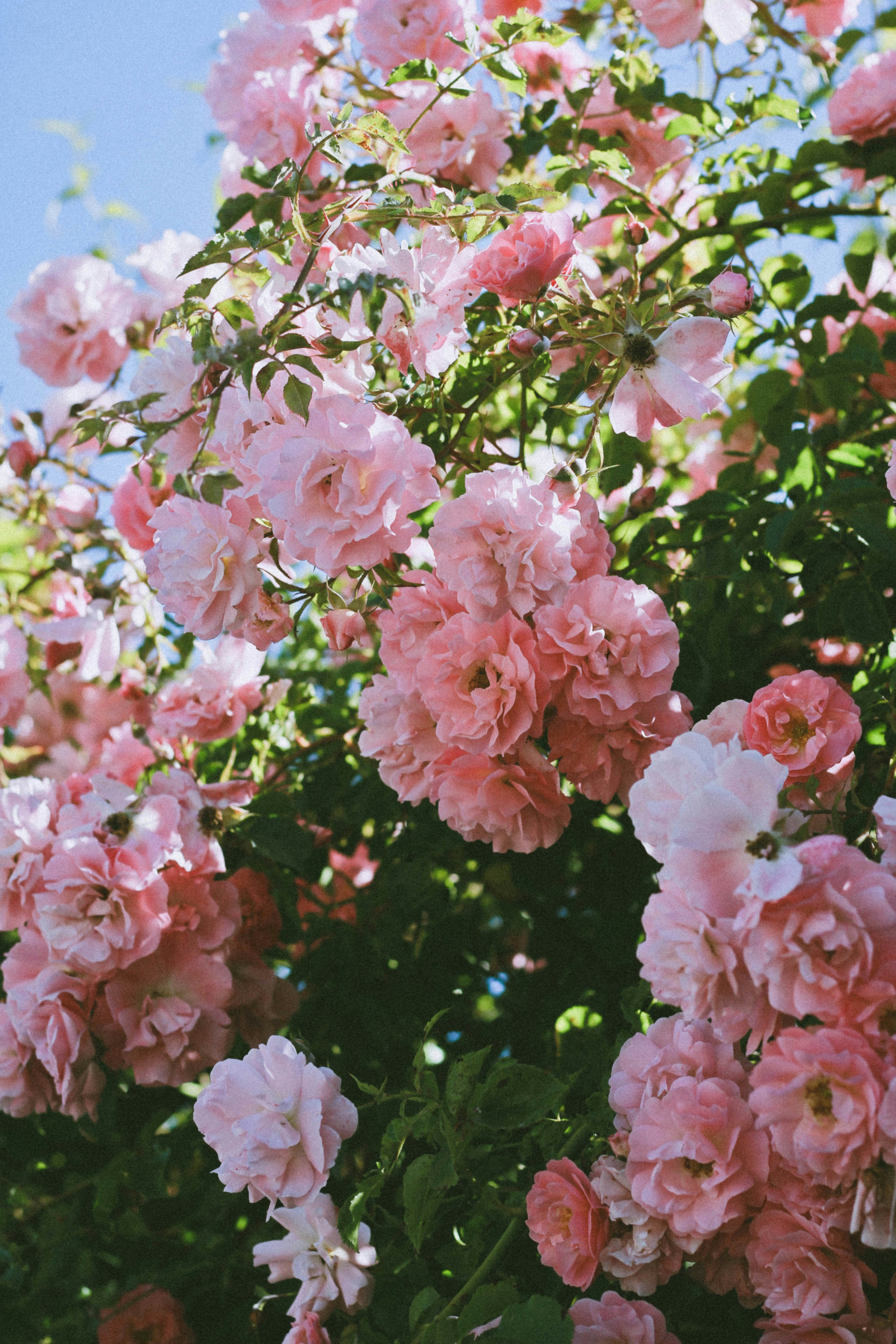
huong-ho-cBe7BxnmmIw
This is a vibrant, sun-drenched photograph capturing a lush, overflowing rose bush in full bloom. The image is filled with clusters of soft pink roses, creating a dense, romantic tapestry of flowers against a backdrop of rich green foliage and a clear blue sky.
**Flowers:**
- The roses are predominantly a delicate, pastel pink, with some blooms appearing lighter — almost white — near the edges of petals or where sunlight hits them most directly.
- Many flowers are fully open, displaying ruffled, multi-layered petals that give them a full, voluminous appearance. Others are partially open or still in bud form, adding texture and depth to the scene.
- The blossoms vary slightly in shade, from creamy pale pink to richer, warmer pinks. Some centers reveal hints of yellow stamens or darker, almost rusty tones, especially in more mature blooms.
- The roses grow in large, cascading bunches, suggesting this may be a climbing or rambling rose variety, densely covering a trellis, fence, or arbor (though no structure is visible).
**Foliage & Stems:**
- Deep green leaves with serrated edges peek through the blossoms, providing a strong contrast to the soft pinks.
- The stems are mostly obscured by the abundance of flowers and leaves, but some thorny tips and green shoots are visible, indicating healthy, vigorous growth.
- Dappled sunlight filters through the leaves, casting subtle shadows and highlights across the blooms and foliage.
**Setting & Lighting:**
- The top left corner reveals a patch of bright, cloudless blue sky, confirming the photo was taken on a sunny day.
- The lighting is natural and warm, enhancing the colors and giving the image a cheerful, dreamy atmosphere typical of spring or early summer.
- The composition is tightly framed around the roses, creating an immersive, almost wall-to-wall floral experience with very little negative space.
**Overall Mood:**
The image evokes feelings of tranquility, romance, and natural beauty. The sheer profusion of blooms suggests abundance and vitality, while the soft color palette and gentle lighting create a serene and idyllic mood — like a perfect moment captured in a secret garden or countryside estate.
In essence, it’s a celebration of nature’s elegance — a flourishing rose bush at its peak, bathed in golden light, radiating grace and joy.
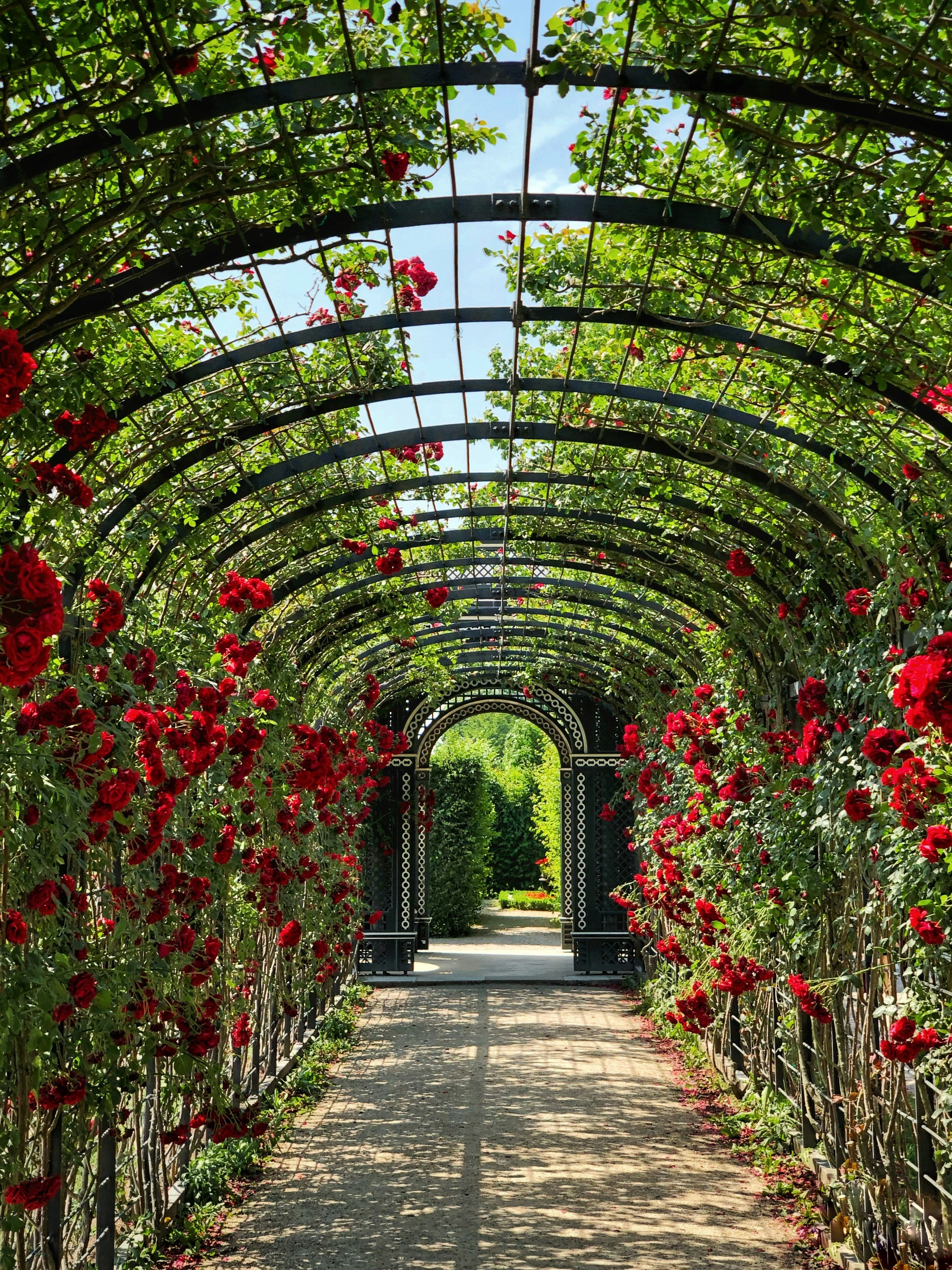
victor-malyushev-w_N-XCjiM0o
This is a stunning, sunlit photograph of a floral arbor or rose tunnel in what appears to be a formal garden. The image draws the viewer’s eye down a long, straight walkway framed by an elegant arching trellis structure.
**Main Structural Elements:**
- **The Arbor Tunnel:** The dominant feature is a series of dark-colored (likely black wrought iron) arched trellises that form a continuous tunnel over a gravel or paved pathway. The arches are evenly spaced and supported by vertical posts on either side. The top of each arch is reinforced with horizontal bars, and the sides appear to have wire mesh or fine lattice panels to support climbing plants.
- **The Pathway:** A light-colored, textured path — possibly made of gravel, decomposed granite, or pavers — runs through the center of the frame, receding into the distance. It is dappled with patterns of sunlight and shadow cast by the overhead foliage.
- **Floral Canopy and Sides:** The entire arbor is densely covered with lush green vines, almost certainly roses. Bright, velvety red roses bloom profusely along both sides of the tunnel and across the top, creating a natural ceiling and walls. The blooms are abundant, full-petaled, and vibrant, standing out dramatically against the green leaves and the dark metalwork.
- **End Archway:** At the far end of the tunnel, there is a more ornate, decorative arched gateway. This final arch features intricate geometric cutouts or latticework, adding a sense of architectural finale to the vista.
- **Background:** Beyond the arched gateway, a well-manicured garden space opens up, bordered by tall, perfectly trimmed green hedges. A patch of bright green lawn and other flowering shrubs can be seen in the distance under a clear blue sky.
**Lighting and Atmosphere:**
- The scene is bathed in bright, natural daylight, suggesting a sunny day.
- Sunlight filters through gaps in the leafy canopy, casting dappled shadows on the path and illuminating individual roses and leaves.
- The sky is visible in patches through the top of the arbor — clear, pale blue with no clouds, enhancing the feeling of warmth and openness despite the enclosed space.
**Composition:**
- The composition uses strong one-point perspective, with all lines converging towards the distant archway, creating depth and inviting the viewer to imagine walking through the tunnel.
- Symmetry plays a key role — the
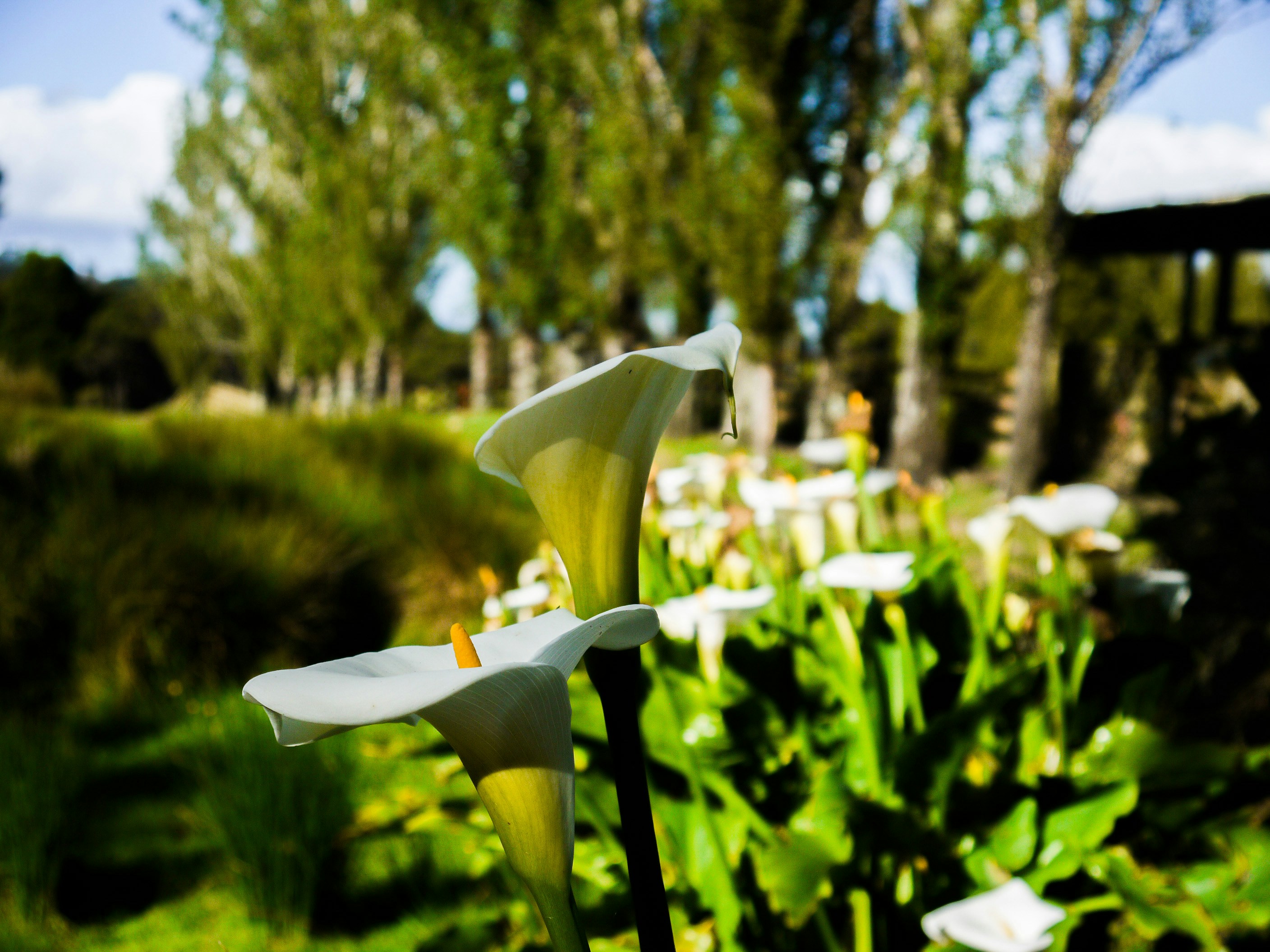
rhys-courtney-meED-gy4dX8
This is a beautifully composed, sunlit photograph centered on white calla lilies in a natural, outdoor setting. The image employs a shallow depth of field, drawing sharp focus to the foreground while softly blurring the background, creating a sense of depth and serenity.
**Foreground:**
- Two prominent white calla lilies are in sharp focus.
- The lower flower is slightly angled toward the viewer, its elegant, trumpet-shaped spathe curling outward. A bright yellow spadix (the central spike) is clearly visible inside the spathe.
- The upper flower stands taller, with its spathe gently drooping backward and slightly to the right. A small, dried tip hangs from its edge, adding a touch of realism and imperfection to its grace.
- Both flowers have thick, dark green stems that contrast vividly with the pale petals and bright green foliage behind them.
- The lighting highlights the smooth, waxy texture of the spathes and casts soft shadows within their curves.
**Midground & Background:**
- Behind the focused flowers, a lush bed of more calla lilies stretches diagonally across the frame — mostly blurred but still identifiable by their white shapes and green leaves.
- The foliage is dense and vibrant, suggesting healthy growth in a moist or shaded environment.
- In the deep background, tall trees with textured bark and leafy canopies rise up against a partially cloudy sky. The trees are out of focus, appearing as soft vertical forms of green and brown, with dappled sunlight filtering through their branches.
- On the far right edge, a dark, indistinct structure is visible — possibly a wooden pergola, fence, or gazebo — adding architectural interest without distracting from the natural subject.
- The sky is partly visible in the upper left and center, showing blue patches mixed with fluffy white clouds.
**Lighting and Atmosphere:**
- The scene is illuminated by bright, natural daylight, likely late morning or early afternoon, which enhances the crispness of the white flowers and the vibrancy of the greens.
- Shadows are present beneath the leaves and between the plants, adding dimensionality and richness to the composition.
- The overall mood is peaceful, tranquil, and natural — like a moment captured in a garden, park, or wetland preserve on a beautiful day.
**Artistic Elements:**
- The photographer has used selective focus masterfully to guide the eye to the main subjects — the two callas — while letting the background suggest a wider, thriving ecosystem
dan-akuna-0DTz2wVUexI
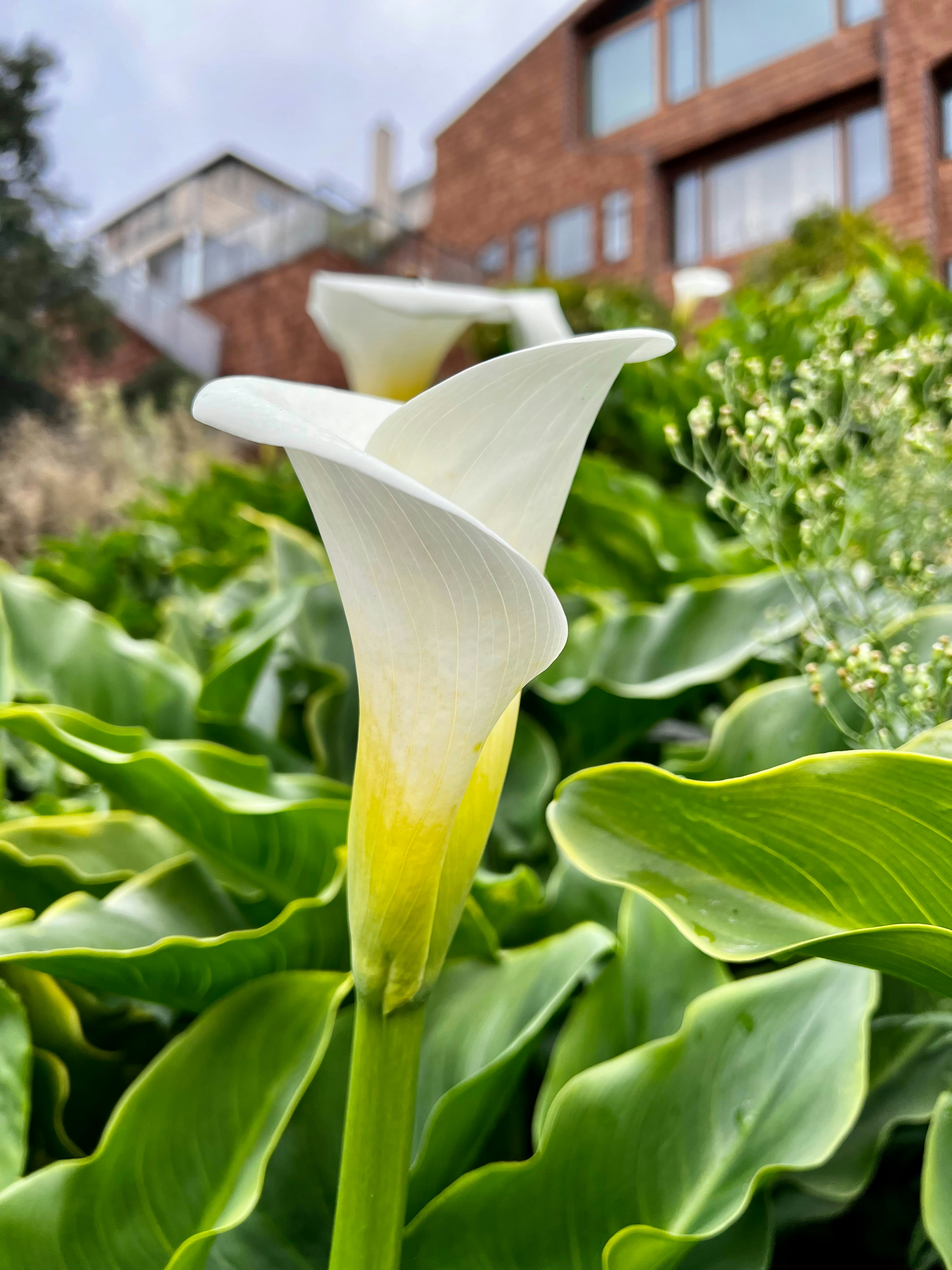
This is a beautifully composed, close-up photograph centered on a single, elegant white calla lily (Zantedeschia aethiopica) in full bloom.
**Main Subject — The Calla Lily:**
- The flower dominates the foreground and is sharply in focus.
- It features a pristine, creamy-white spathe (the large petal-like bract) that gracefully curves into a smooth, funnel shape with a pointed tip curled slightly outward.
- At the base of the spathe, near where it meets the stalk, the color gently transitions to a soft, buttery yellow.
- The central spadix (the finger-like structure inside the spathe) is not fully visible but is implied by the curved form of the spathe.
- The flower is supported by a thick, sturdy green stem.
**Surrounding Foliage:**
- The calla lily is nestled among its own broad, richly textured leaves. These leaves are a vibrant, deep green with prominent veins and wavy, ruffled edges that create a lush, almost tropical backdrop.
- To the right of the main bloom, there’s another plant with delicate, airy clusters of tiny white or pale-green flowers (possibly a type of gypsophila or baby's breath), adding textural contrast and depth to the scene.
**Background:**
- Behind the lush greenery is a modern brick building with clean lines and large rectangular windows framed in dark material.
- To the upper left, another structure with white balconies or railings is partially visible, slightly blurred.
- The sky above is overcast, providing diffused, even lighting that enhances the natural colors without harsh shadows.
**Composition and Mood:**
- The photographer used a shallow depth of field, keeping the calla lily in crisp focus while softly blurring the background foliage and buildings. This technique draws the viewer’s eye directly to the flower.
- The angle is slightly low, looking up at the bloom, which gives it a sense of stature and prominence.
- The overall mood is serene, fresh, and quietly celebratory of natural beauty amid an urban setting. The image captures the grace of the calla lily against its architectural surroundings, creating a harmonious blend of nature and human construction.
In summary, this image presents a strikingly detailed portrait of a calla lily thriving in a cultivated garden space, juxtaposing organic elegance with structured urban architecture under soft, cloudy skies.
stephen-hui-J3__44tDpAU
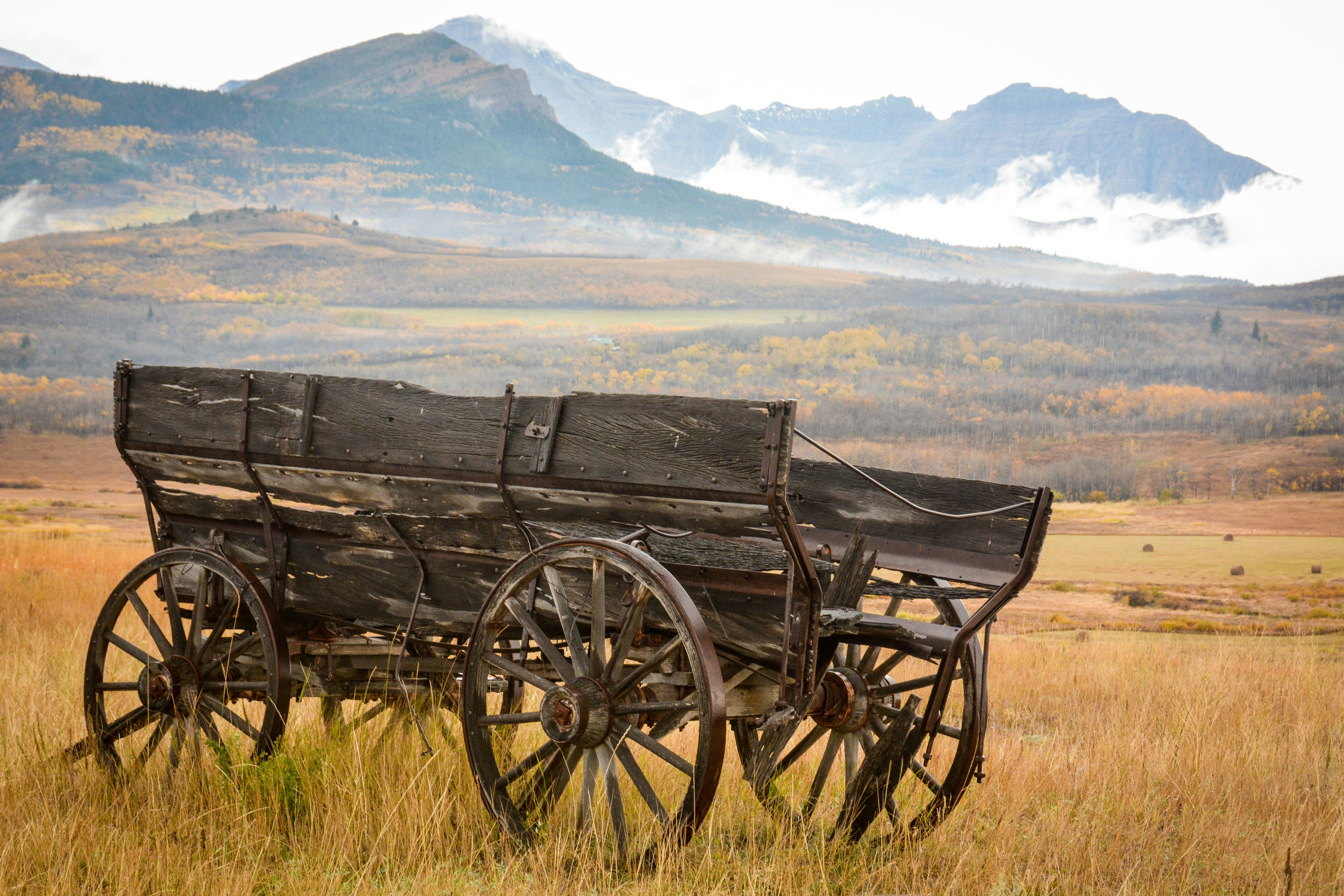
This is a tranquil, scenic photograph capturing a rustic and nostalgic moment in a vast, open landscape. Here’s a detailed breakdown of everything visible:
**Foreground:**
- **Old Wooden Wagon:** The dominant subject is a weathered, antique wooden wagon or cart, likely from the late 19th or early 20th century.
- It features large, spoked iron-rimmed wheels — two at the front (smaller) and two at the rear (larger), typical of farm or freight wagons.
- The body of the wagon is constructed from dark, aged wooden planks, showing signs of heavy use, cracking, fading, and rust along the metal fasteners and braces.
- The wagon bed is rectangular with low sides and appears empty, with remnants of ropes or chains draped over its structure.
- It sits grounded in tall, dry, golden-brown grasses, suggesting autumn or an arid season.
**Midground:**
- **Rolling Grassland / Meadow:** The field extending behind the wagon is expansive and golden-hued under soft, diffused lighting.
- Scattered throughout the field are several neatly rolled bales of hay or straw, indicating recent harvesting.
- In the distance, there's a transition to a denser area of trees — primarily aspen or similar deciduous species — displaying vibrant autumn foliage in shades of yellow and gold, contrasted with darker green coniferous trees.
**Background:**
- **Layered Hills and Forests:** Beyond the meadow, rolling hills stretch across the horizon, covered in a mix of forest and shrubland.
- The color palette here includes muted greens, browns, and yellows, blending into the hazy atmosphere.
- **Majestic Mountain Range:** Dominating the distant background is a dramatic range of rocky mountains.
- The peaks are rugged and steep, some showing exposed rock faces and possibly lingering snow patches near their summits.
- Low-hanging clouds or mist wrap around the mid-slopes, partially obscuring them and adding depth and mystery to the scene.
- The atmospheric perspective gives the mountains a soft, bluish-gray tone, enhancing the sense of scale and distance.
**Atmosphere and Lighting:**
- **Lighting:** The scene is bathed in soft, diffuse light, likely from an overcast sky or during early morning or late afternoon hours. There are no harsh shadows, contributing to the calm and contemplative mood.
-
jon-tyson-dkFX98yIBvU
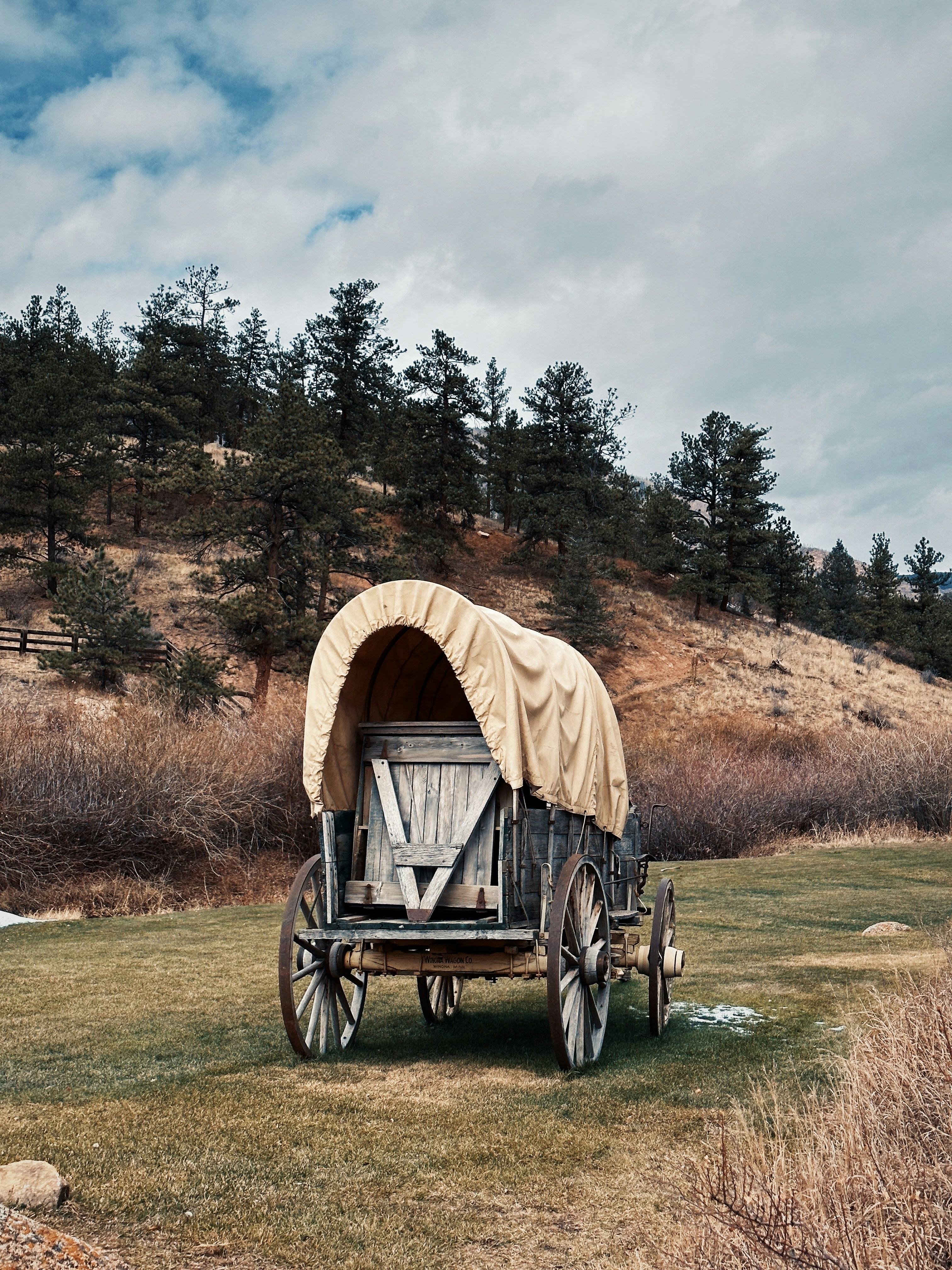
This is a tranquil, scenic photograph centered on a vintage wooden covered wagon, often called a “Conestoga” or “prairie schooner,” positioned on a grassy field under a cloudy sky. The overall mood is nostalgic and evocative of American frontier history.
**The Covered Wagon:**
- **Structure**: The wagon is constructed from weathered gray wood, giving it an aged, authentic appearance. The body has vertical slats, and the rear features a distinctive V-shaped brace or support structure. The wheels are classic spoked wooden wheels with metal rims, showing signs of use.
- **Canopy**: A taut beige canvas cover (the “bonnet”) arches over the top, resembling the curved hull of a ship — hence “prairie schooner.” The fabric appears sturdy but not new, with natural folds and creases.
- **Positioning**: The wagon is parked facing away from the viewer, slightly angled to the right. We’re looking at its rear and left side. It sits stationary on gently sloping, patchy green and brown grass.
**Foreground and Surroundings:**
- The foreground consists of dry, straw-colored grasses and small tufts of vegetation, hinting at late autumn or early spring.
- A few scattered rocks are visible near the bottom edge of the frame.
- The ground slopes gently upward behind the wagon toward a hillside.
**Midground and Background:**
- Behind the wagon rises a rolling hill, partially covered in dormant golden-brown grasses and scrubby brush.
- Clusters of dark green coniferous trees (likely ponderosa pines) dot the hillside, varying in size and height. Some stand tall, while others are smaller, giving depth to the landscape.
- On the far left, a rustic wooden fence line follows the contour of the hill, reinforcing the pastoral or historical setting.
**Sky and Atmosphere:**
- The sky fills the upper third of the image and is dominated by soft, layered clouds — mostly white and gray, with hints of blue peeking through.
- The lighting is diffuse and even, suggesting an overcast day or late afternoon. Shadows are gentle and soft, without harsh contrast.
- The overall color palette is earthy and muted: beiges, grays, greens, and browns dominate, creating a calm, subdued aesthetic.
**Composition:**
- The wagon is placed off-center, adhering loosely to the rule of thirds.
- The diagonal slope of the land and trees draws the eye up

haziq-mehboob-HyCOq0772zI
This is a highly atmospheric and cinematic image that blends elements of rural Americana with science fiction mystery. Here’s a detailed breakdown of everything visible:
---
**Foreground:**
- **Three boys**: Standing side by side on a grassy path or dirt lane, with their backs to the viewer. They appear to be between 8 and 12 years old.
- The boy on the left wears a dark olive-green T-shirt and dark pants. His posture is relaxed, hands possibly in pockets.
- The central boy, slightly shorter, wears a grayish-green sweatshirt and dark pants. He stands straight, gazing forward intently.
- The boy on the right wears a black long-sleeved shirt and dark jeans. His arms are at his sides, also looking forward with quiet awe.
- Their body language conveys stillness, wonder, and perhaps apprehension.
---
**Midground:**
- **A weathered farmhouse**: Situated behind the children, centered in the composition. It appears abandoned or long neglected:
- Wooden clapboard siding is faded and peeling, suggesting decades of exposure to weather.
- Red roof tiles (possibly asphalt shingles) look aged; some may be missing.
- Windows are either broken, boarded up, or dark and empty — no lights visible inside.
- A small front porch with steps is partially shadowed, adding to its eerie atmosphere.
- Two chimneys rise from the roof, one near the peak and another off-center.
- Shrubs and overgrown weeds surround the house, merging it into the landscape.
- **Flanking vegetation**:
- To the left of the house stands a tall, dark evergreen tree.
- To the right, several smaller pine or fir trees cluster together, framing the scene symmetrically.
- **Field/landscape**:
- Extends into the distance around the house — dry, brownish-yellow grasses suggest late summer or early autumn.
- A narrow path leads toward the house and divides the field, subtly guiding the eye inward.
- The horizon line is flat and distant, emphasizing isolation.
---
**Background and Sky:**
- **Dramatic, stormy sky**: Dark, swirling clouds dominate the upper portion of the image. Hints of stars peek through gaps in the gloom, suggesting nighttime.
- The clouds are rendered with high contrast and depth, creating an ominous, foreboding mood.
- **Flying Saucer/UFO**: Floating directly above
alex-vd-slikke-NxGj8lnxbUc
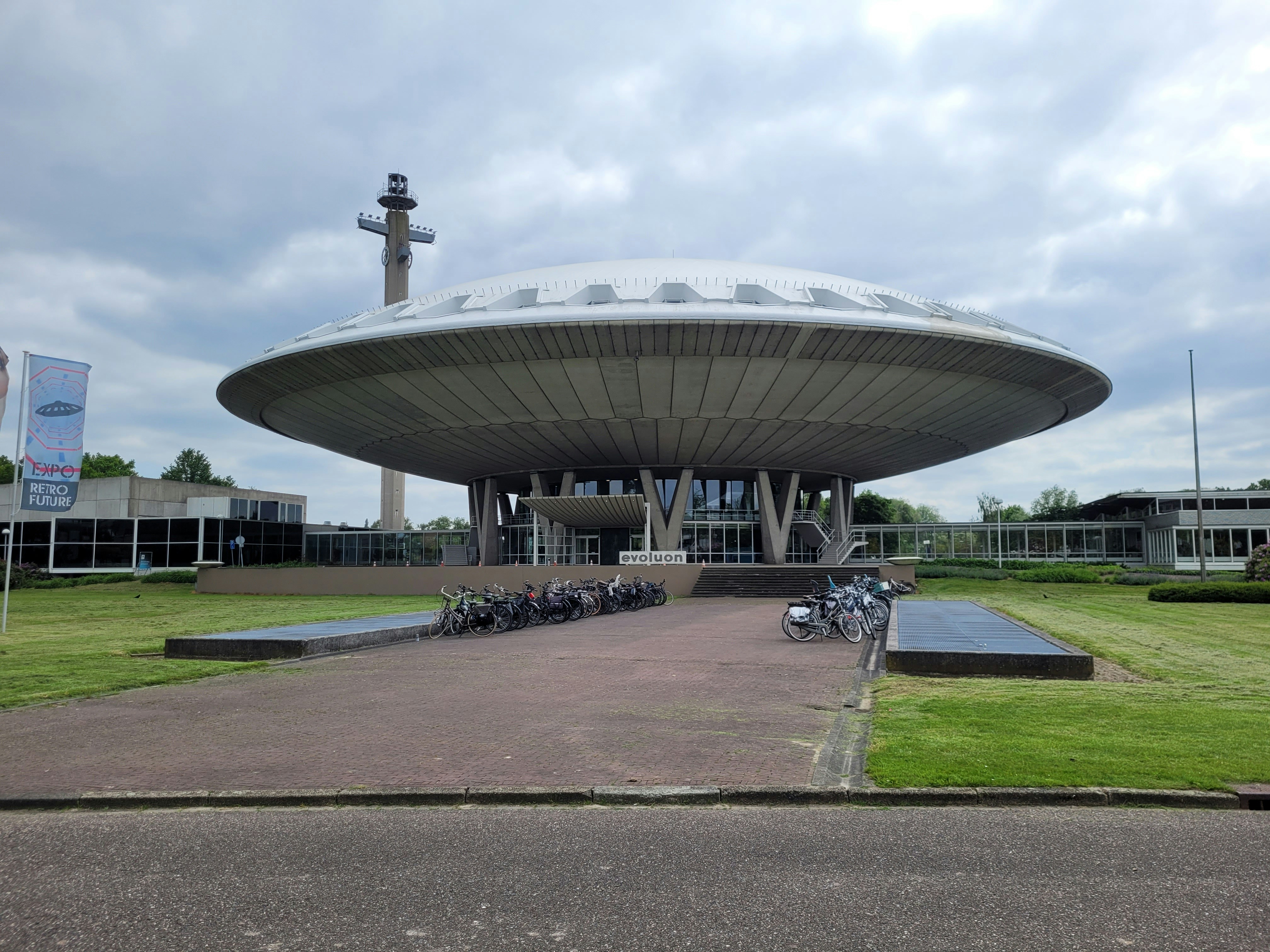
This is a wide-angle, eye-level photograph of the Evoluon, a distinctive futuristic building located in Eindhoven, Netherlands. The image captures the iconic structure under an overcast sky, with its surroundings including paved areas, grass, parked bicycles, and nearby buildings.
**Main Subject — The Evoluon:**
- **Architecture**: The building is most notable for its unique flying saucer (or UFO) design. It consists of a massive, flat, circular disc-like roof that appears to float above a central supporting structure.
- **Structure**: The disc is held aloft by a ring of 12 large, tapering concrete columns (V-shaped or Y-shaped supports), which converge towards the center, creating a spacious, column-free entrance area below.
- **Exterior Materials**: The underside of the saucer roof features horizontal ribbing or paneling in a light gray or off-white color, consistent with the architectural style of the 1960s when it was built. The main entryway has large glass windows and doors, set within the concrete support structure.
- **Entrance Area**: In front of the main glass entrance, there are stone steps leading up to the lobby. A sign reading “evoluon” is visible at ground level near the entrance.
- **Tower Structure**: Behind and slightly above the left side of the Evoluon, a tall, slender white tower can be seen. This is likely the "Evoluon Tower" (formerly known as the Philips Pavilion Tower / PTT Tower), which houses the original control rooms for the building’s climate systems and now contains an observation deck. Atop this tower is a cross-shaped platform holding what appear to be scientific instruments or antennae.
**Foreground and Surroundings:**
- **Paved Courtyard**: In front of the building is a large, rectangular courtyard made of reddish-brown paving stones. Numerous bicycles — approximately 15–20 — are parked in an orderly line along the edge of the courtyard closest to the photographer.
- **Water Features**: Embedded in the pavement on either side of the main path toward the entrance are two shallow, rectangular pools or reflecting ponds, bordered by low stone edges. They contain dark water.
- **Lawn Areas**: On both sides of the paved courtyard are stretches of well-maintained green lawn.
- **Road**: At the very bottom edge of the frame, a strip of asphalt road is visible.
**Adjacent Structures and Signs:
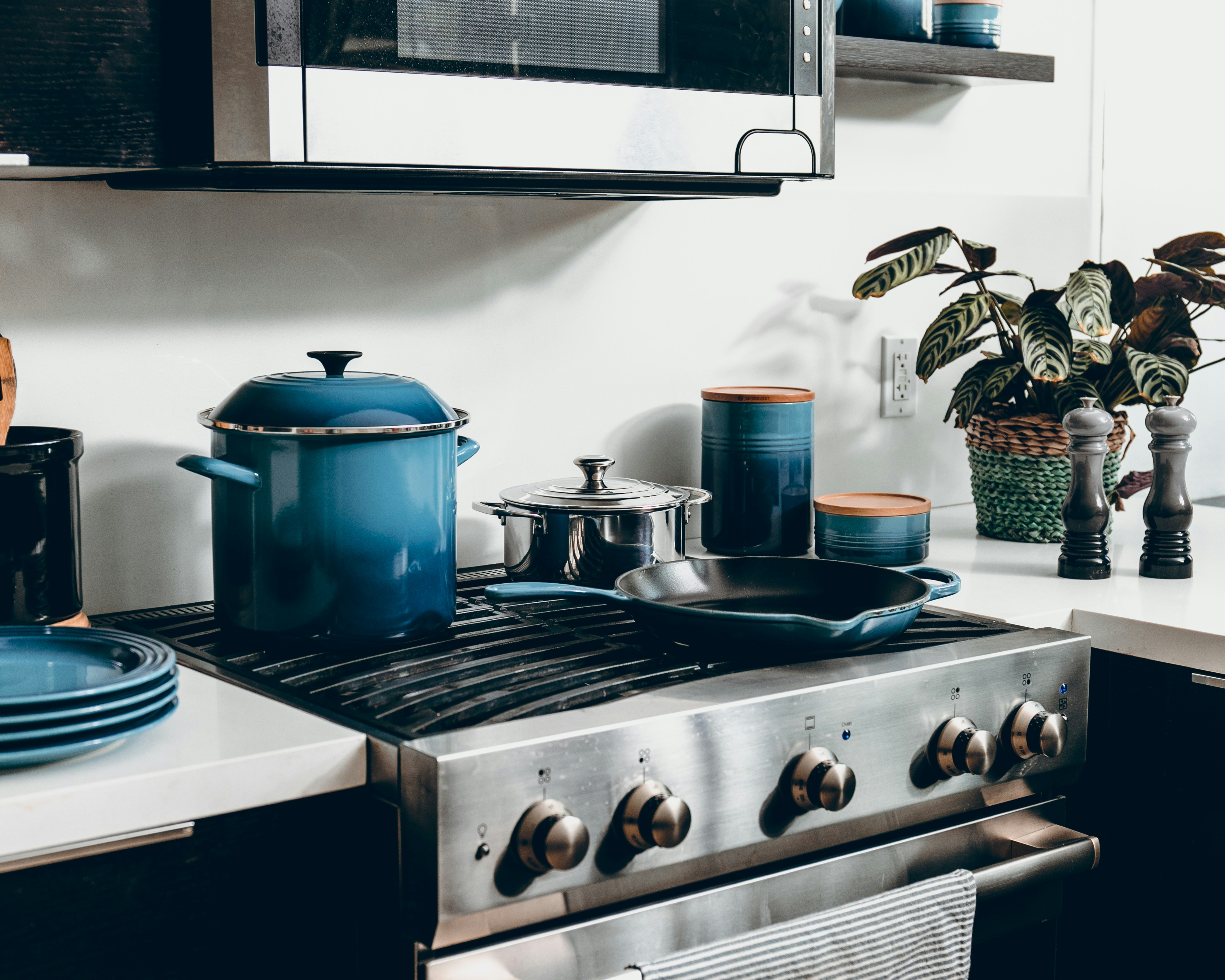
dane-deaner-wkC8EX8y9Mc
This is a beautifully styled, well-lit photograph of a modern kitchen scene centered around a stainless steel gas stove and oven. The image evokes a clean, organized, and inviting atmosphere with a focus on functionality and aesthetic harmony.
**Stove and Cookware:**
- **Gas Stove & Oven:** The centerpiece is a professional-style stainless steel gas range with a black cast iron grating. Below the cooktop, you see five large, brushed-metal control knobs with black inserts for precise temperature adjustment. A matching stainless steel oven door is visible at the bottom, with a neatly folded striped dish towel (white and grey/blue) hanging from its handle.
- **Cookware on Stove:**
- On the left burner sits a large, vibrant teal/blue enameled cast iron Dutch oven with a matching lid and dual side handles.
- To its right is a medium-sized aluminum or stainless steel saucepan with a glass or metal lid and a single loop handle.
- In front, spanning two burners, lies a dark teal/blue cast iron skillet; it matches the Dutch oven and is resting directly on the grates.
**Countertop Details:**
- **Left Side (of stove):** A stack of four matching teal/blue ceramic plates rests beside the stove. Behind them, partially visible, is a matte black ceramic utensil holder containing wooden cooking tools.
- **Right Side (of stove):**
- Two tall, cylindrical storage canisters in the same teal/blue glaze as the pots have light wooden lids. They are stacked slightly offset, one taller than the other.
- Beside them stands a lush, green potted plant — likely a Maranta leuconeura (Prayer Plant), noted for its striking variegated leaves with red veins and patterned foliage. It’s housed in a woven green basket pot.
- Next to the plant are two classic pepper and salt mills made of dark wood or resin with silver-toned metal tops.
- White countertop surface provides a bright, clean contrast to the darker elements.
**Upper Area:**
- Directly above the stove is a microwave oven built into the cabinetry. It has a sleek black glass front and silver metallic frame. A small shelf mounted under the microwave holds two small blue bowls or ramekins, echoing the color palette.
- The wall behind the stove is painted white, which makes the colors pop. On the right wall, a standard US electrical outlet is visible near the potted plant.
**Color

lobostudio-hamburg-4lf8mVuZESQ
This is a studio-style photograph featuring a single pair of well-worn, brown leather work boots, positioned centrally against a stark, seamless white background. The lighting is even and soft, casting gentle shadows beneath the boots, which emphasizes their form and texture without harsh contrasts.
**Detailed Description:**
- **Type and Style:** These are high-top work boots or hiking boots, designed for durability. They appear to be made primarily of thick, rugged leather that has softened and creased over time.
- **Color and Wear:** The original color is a medium tan or light brown, but it’s heavily weathered. There are prominent scuffs, scratches, and darkened areas from dirt, grime, and use—especially along the toes, sides, and heel counters. The leather shows signs of fading and cracking in places, indicating extensive wear.
- **Lacing System:** The boots have sturdy laces threaded through metal eyelets. The laces themselves are similarly worn, slightly frayed, and discolored—notably darker in some areas from dirt absorption. They are tied loosely. A small, light-colored tag (perhaps a brand label or size tag) protrudes near the top of the right boot.
- **Construction:** Visible stitching runs along the toe caps and around the edges where different parts of the boot meet. The soles are thick and appear to be rubber or heavy-duty composite material, with layered construction and visible wear patterns. The tread looks slightly flattened from use, especially on the balls and heels. The sole edges show discoloration and slight separation in places, typical of aged footwear.
- **Overall Impression:** The boots look rugged, honest, and lived-in. They convey a sense of hard work, outdoor labor, or frequent travel. Despite their worn condition, they retain structural integrity—they’re not broken, just deeply used.
- **Composition:** The clean white background isolates the boots completely, making them the undisputed focal point. This minimalist presentation elevates the humble object into an almost symbolic one—perhaps representing resilience, endurance, or the dignity of labor.
In sum, the image presents a compelling portrait of functional footwear transformed by age and use into a textured, character-rich artifact.

ray-reyes-AVQc8i57qV4
This is a highly detailed, close-up macro photograph of a partially smoked cigarette resting on what appears to be dark, textured ash or charred material.
**Main Subject — The Cigarette:**
- The cigarette is positioned diagonally, from the upper right toward the lower left.
- It features a light orange, textured paper wrapper with visible tiny perforations — typical of a filter-tipped cigarette (possibly a king-size).
- The filter end (right side) remains intact and unburned, retaining its original color.
- The lit end (left side) is consumed by a thick, crinkled layer of gray and black ash. The ash is clumpy and irregular, clinging tightly to the cigarette body at the burn line.
- A thin ring of blackened, carbonized tobacco lies between the white ash and the untouched orange paper — the "burn line" indicating recent combustion.
- No active glow or smoke is visible; it appears extinguished or nearly so, suggesting a moment of stillness.
**Surface & Background:**
- The cigarette rests on an uneven, gritty black surface composed of what looks like crushed ash, burnt tobacco, or possibly charred debris — giving the image a raw, post-combustion feel.
- The texture of this base is coarse and fragmented, providing visual contrast to the smoother cigarette paper.
- The background is entirely out of focus, blurred into soft gradients of brown and charcoal gray, creating a shallow depth of field that isolates and emphasizes the cigarette as the focal point.
**Lighting & Color Palette:**
- The lighting is soft and directional, likely coming from above or the front-left, highlighting the textures of the ash and cigarette paper while casting subtle shadows beneath.
- The overall color scheme is muted and somber — dominated by blacks, grays, and earthy browns, with the orange cigarette serving as a single point of warm contrast.
- The mood is gritty, intimate, and contemplative — evoking themes of transience, consumption, decay, or the aftermath of action.
**Photographic Style:**
- This is not a casual snapshot; it’s a deliberately composed image using macro photography techniques to elevate a mundane object into something visually compelling.
- The selective focus, dramatic lighting, and symbolic subject matter give the photograph an artistic, almost cinematic quality — reminiscent of still-life imagery used in storytelling, advertising, or conceptual art.
In summary, this image captures the quiet aftermath of smoking — the fragile, crumbling ash, the lingering form of the cigarette, all set

wooof-woof-ItvLZeoJCgk
This is a close-up, front-facing portrait of an older, black dog captured mid-yawn against a clean, bright white background. The dog’s expression is the focal point — its mouth is wide open in a full yawn, revealing its pink tongue, the roof of its mouth, and all of its teeth, which are yellowed and slightly worn — a clear sign of age. A few lower teeth appear to be missing or significantly reduced.
The dog’s eyes are closed tightly, giving it a look of deep relaxation or fatigue. Its muzzle is predominantly black, but there’s significant graying around the snout and jawline, further indicating its senior years. A few long, light-colored whiskers extend from either side of its muzzle.
Its ears are floppy and hang down on each side of its head — typical of breeds like Labrador Retrievers or similar mixed breeds. The coat is short, black, and glossy, with some scattered gray or white hairs visible near the neck and chest area, again signaling aging.
The lighting is soft and even, likely studio lighting, highlighting the texture of the fur and the details in the dog’s face without harsh shadows. The composition is centered and intimate, focusing entirely on the dog's expressive face and capturing a candid, almost humorous moment of canine tiredness. The overall effect is endearing, relatable, and conveys personality — as if the dog is saying “I’m just so done with today.”
There is no collar, leash, or visible accessories. The white background isolates the subject completely, making it ideal for use in advertising, editorial content, or social media about pets, aging animals, or simply funny/whimsical moments.

national-institute-of-allergy-and-infectious-diseases-nC6ZdM-WeCY
This is a highly detailed, colorized scanning electron micrograph (SEM) image showing what appears to be **SARS-CoV-2 virus particles** (the virus that causes COVID-19) on the surface of an infected cell.
Here's a detailed breakdown of everything you see:
---
### 🔬 **Main Subject:**
The primary focus is on **virus particles budding from or attached to the surface of a host cell**. This is consistent with images released by the National Institutes of Health (NIH) and CDC during the early stages of the pandemic.
---
### 🎨 **Colorization:**
The image has been artificially colorized for clarity and visual impact — the colors do not represent the actual pigments of the viruses or cells.
- **Orange spheres**: These are the **SARS-CoV-2 virions**. They appear as small, round particles with a somewhat bumpy texture, which corresponds to the spike proteins (S-proteins) protruding from their lipid envelope — giving them the “crown-like” appearance that names the coronavirus family.
- **Teal/cyan structures**: These are **surface projections of the infected human cell**, most likely **microvilli or cellular extensions**. The cell’s membrane is studded with these finger-like protrusions, many of which are covered or surrounded by the orange viral particles.
---
### 🧬 **Structural Details:**
- The **orange virus particles** vary in size and density. Many appear clustered together, especially in the upper right quadrant, suggesting active replication or release from the cell.
- Some particles show more definition than others — possibly due to depth of field or stage of viral maturation.
- The **teal cellular surface** looks complex and textured, indicating the dynamic nature of the cell membrane during infection. It is irregular, knobby, and densely packed with projections, which helps provide structural context for where the virus is attaching and budding.
---
### 📸 **Imaging Technique:**
This is a **scanning electron microscope (SEM)** image. Unlike transmission EM, SEM provides 3D-like surface detail — you can see contours, heights, and textures of the cell surface and the individual virions. The image was likely taken after chemically fixing the sample, coating it with metal (like gold), and then scanning it with electrons to generate a high-resolution topographical map.
---
### 🧭 **Biological Significance:**
This image captures one of the earliest known visualizations of S

joe-yates-wNOymf_yTUA
This is a warm, intimate, and emotionally resonant photograph centered on two people holding hands. The image captures a tender moment, likely at sunset or sunrise, with strong backlighting creating a soft, glowing effect.
Here’s a detailed breakdown of what you see:
---
**Subject:**
- Two hands are clasped together in the center of the frame — one hand gently holding the other’s fingers.
- The hands appear to belong to adults; one is slightly larger and more masculine in shape, while the other is smaller and more slender, suggesting a male and female couple (though not explicitly confirmed).
- On the ring finger of the smaller hand (likely the left hand), there appears to be a delicate gold or rose-gold band — possibly an engagement ring or wedding band — adding symbolic significance to the gesture.
- Both individuals are wearing long sleeves:
- The arm on the **left** is clad in a dark, ribbed or textured fabric — perhaps black or dark olive green knit — ending just above the wrist.
- The arm on the **right** wears a lighter-colored sleeve — light blue denim or cotton — also rolled or fitted at the wrist, revealing smooth skin.
---
**Composition & Lighting:**
- The shot is tightly framed around the hands, drawing the viewer’s eye directly to the act of connection.
- The **sun** is positioned behind the hands, creating a dramatic backlight that rims both arms and hands with golden light — often called “rim lighting.”
- A distinct **lens flare** appears near the elbow/arm of the person in dark clothing — a circular burst of warm orange and green hues — adding an artistic, dreamy touch.
- The background is softly blurred (shallow depth of field), consisting of out-of-focus natural elements — possibly tall grasses, field weeds, or brush — bathed in warm amber and golden tones.
- The sky above is overexposed to white, indicating the intensity of the sun, which washes out details and enhances the silhouette-like quality of the scene.
---
**Color Palette:**
- Dominated by **warm tones**: oranges, yellows, and ambers from the sunlight.
- Contrasted by cool blues and deep blacks/greens in the clothing.
- Skin tones are warmly lit, appearing golden and radiant due to the sunlight.
- Overall atmosphere feels romantic, nostalgic, and serene.
---
**Mood & Emotion:**
- There’s a palpable sense of **connection, support, love, and intimacy** conveyed through the gentle

nathan-dumlao-n1jhtaEHIhg
This is a top-down, close-up photograph of a single sunny-side-up fried egg cooking in a small, dark non-stick skillet on a black gas stovetop.
**The Egg:**
- The egg is perfectly centered in the pan.
- The yolk is vibrant, round, and glossy orange, appearing slightly raised and unbroken — still liquid at its core.
- The egg white is mostly opaque and solidified around the yolk but remains thin and translucent near the edges. It has crisped up slightly around the perimeter, forming a delicate, lacy ruffle where it meets the hot oil.
- Small bubbles are visible in the surrounding cooking oil, suggesting the pan is actively heated.
**The Pan:**
- It’s a small, round skillet, likely non-stick, with a matte black interior.
- A portion of the handle is visible at the bottom edge of the frame — it appears to be made of metal or wood with some rust or discoloration near the base.
- Oil or butter coats the bottom of the pan, shimmering around the egg and pooling slightly beneath it.
**The Stovetop:**
- The grate underneath is made of heavy black cast iron, with a grid pattern of intersecting bars that form diamond-shaped openings.
- The grate shows signs of use — slight texture, minor staining, and subtle wear, indicating this is likely a well-used kitchen stove.
**Composition & Lighting:**
- The image is tightly framed, focusing exclusively on the pan and egg, with minimal background distractions.
- Lighting is soft and diffused from above, highlighting the glistening yolk and creating subtle reflections on the oil.
- The color palette is dominated by dark tones (black pan, grate) contrasted sharply with the bright yellow-orange of the yolk and the pale white of the egg — creating a visually striking and appetizing image.
- The overall mood is intimate and focused, capturing a simple, classic cooking moment in high detail.
This image evokes the cozy simplicity of home cooking and the sensory appeal of a freshly fried egg — crisp edges, runny yolk, sizzling oil — all captured in one clean, compelling shot.

kim-giseok-tU0jPrumTPQ
This is a vivid, dynamic winter scene set in a snowy, forested mountainous region. The image captures a moment of human interaction with the machinery of winter maintenance.
**Main Subject – Snowplow Truck:**
Dominating the center-left of the frame is a large, bright yellow snowplow truck, likely a Western Star or similar heavy-duty model, identifiable by the prominent “W” logo on its front grille. The truck is equipped with a massive orange snow blower attachment mounted on its front. This blower is actively operating — a powerful, swirling plume of fine white snow is being expelled dramatically to the left side of the road, indicating the machine is clearing the roadway. The truck’s body includes a dump bed behind the cab. Its headlights are on, casting beams forward. Visible details include multiple wheels (six rear tires), side mirrors, and amber warning lights atop the cab. The vehicle is moving forward along the road.
**Human Figure:**
On the right side of the road, standing on the snow-covered shoulder, is a person viewed from the back. They are dressed for cold weather in a bright red winter coat with a fur-trimmed hood, gray pants or leggings, black-and-white patterned knee-high socks or boots, and a blue knit hat. The person appears to be photographing or filming the snowplow with a small device held up to their face — possibly a smartphone or compact camera. Their posture suggests admiration or curiosity.
**Environment and Setting:**
The location is rural and scenic. The road, which curves gently into the distance, is partially cleared but still shows a mixture of snow, slush, and exposed dark asphalt. It’s flanked on both sides by dense stands of tall evergreen trees — pines or spruces — many of which are dusted with snow. In the background, rolling hills or mountains are partially obscured by low-hanging fog or clouds, giving the scene a sense of depth and atmospheric moody beauty.
**Lighting and Atmosphere:**
The sky is uniformly overcast and grey, typical of a winter day, providing soft, diffused lighting without harsh shadows. The color palette is a stark contrast between the earthy browns and greys of the road and distant hills, the deep greens and whites of the forest, and the bright artificial colors — yellow and orange of the plow, red of the coat, and blue of the hat — that pop against the muted natural tones. The action of snow spraying creates a sense of motion and